COMPANION ANIMALS
 EQUINE
 Farm Animals




In this section, you’ll find tools to support you in doing what you do best, namely providing your patients with exceptional care and helping your clients keep their pets healthy, happy and part of their lives… for all of their lives.
Tools for clinics
2026-09-22
 01:00 min
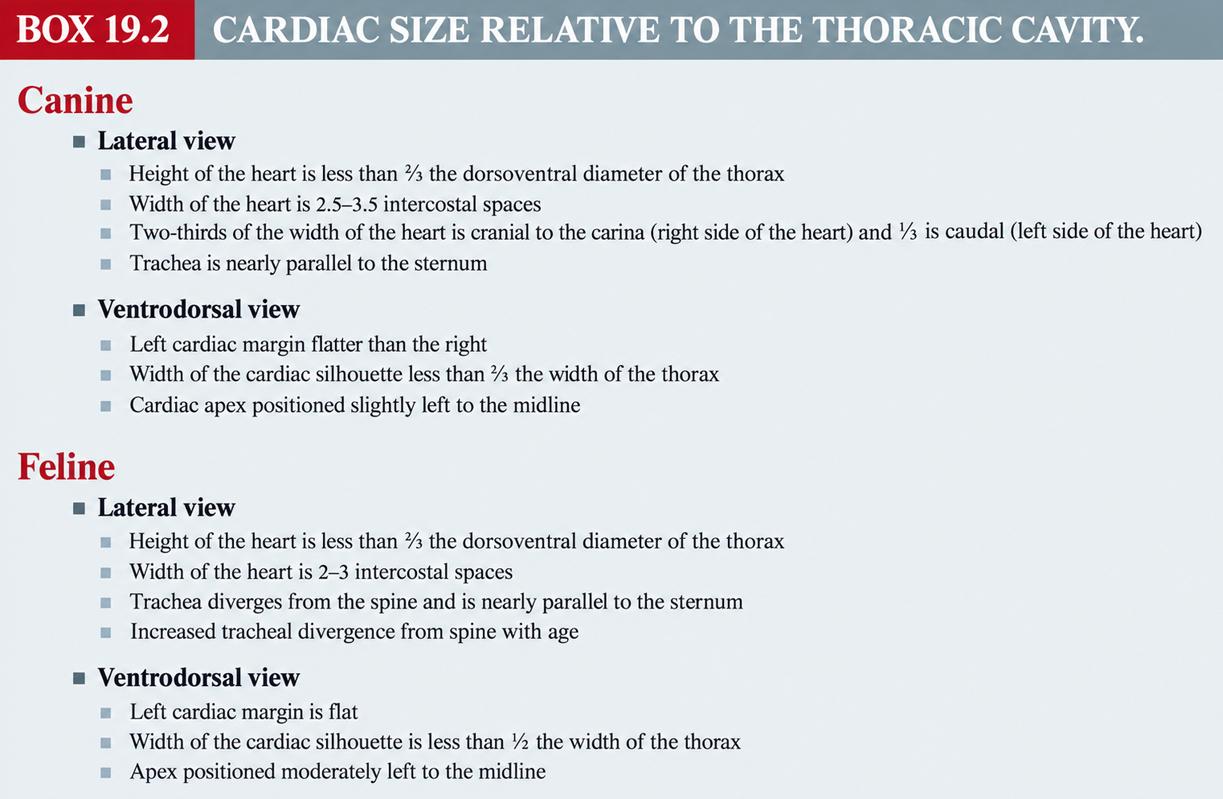
Knowledge of the normal radiographic appearance and topographic anatomy of the heart is required to recognize the abnormal. The heart size can be evaluated by subjective assessment (box 19.2) or objectively using a ratio of cardiac size to vertebral length, called a vertebral heart score (fig. 19.5). The cardiac shape is equally important in determining the presence of disease as alterations in cardiac shape may not necessarily affect cardiac size. Poorly positioned and/or centered radiographs...
Sponsored by


2026-08-17
01:00 min
Chambers of the heart are located within specific segments along the clock. The clock-face analogy is similar in cats, except that the left atrium is located more to the left of the cardiac silhouette rather than dorsally at the caudal cardiac base like it is in dogs.
If you found this helpful, explore the full content in Atlas of Diagnostic Imaging of Dogs and Cats.
Discover the full book here. Download the tool for full details — The diagram above is a preview. The downloadable tool includes...
Sponsored by

2026-08-12
08:00 min
Generalized lymphadenomegaly is defined as the abnormal enlargement of >2 non-contiguous peripheral and/or visceral lymph nodes (LNs); it occurs more frequently in dogs, while it is rare in cats. Routinely palpable peripheral LNs in healthy dogs include mandibular, prescapular, inguinal, and popliteal LNs. LNs which may become palpable, if diseased, include facial, retropharyngeal, axillary, mesenteric, and sacral LNs.
In the case of localized lymphadenomegaly, the tissue drained by the...
Sponsored by

2026-08-03
08:00 min
The number of circulating white blood cells (WBCs) depends on the production of WBCs by the bone marrow and their release into the blood, their rate of egress from the blood into the tissues, and the ratio between the circulating pool and the marginated pool (capillaries, veins, lungs, spleen, and liver) since the total WBC count only considers the circulating pool. The main causes of an increased number of leukocytes (leukocytosis) are inflammation, infection, autoimmune disease, tissue...
Sponsored by

2026-07-24
08:00 min
Decreased appetite is a non-specific finding and a common reason for the owner to seek medical care for their pets. A complete lack of appetite is referred to as anorexia, while the term hyporexia better identifies a partial decrease in appetite. Decreased appetite must be differentiated from the inability to eat, as seen in diseases causing pain at the opening of the mouth or in oral dysphagia. This difference is crucial but not always apparent to the owner.
Regulating food intake involves...
Sponsored by

2026-07-10
02:00 min
Introducing a new cat without a plan can lead to chronic stress for both clients and their pets. With the right approach, intercat aggression can be dramatically reduced and cats can adapt to living together more comfortably. This cheat sheet, based on the 2024 AAFP Intercat Tension Guidelines, gives you practical tips for guiding clients through the introduction process and building a supportive environment for all cats in the home.
Sponsored by


2026-06-22
08:00 min
A heart murmur is a sound made by turbulent blood in or near the heart. This condition can be due to a reduction in blood viscosity, an increase in blood volume, or the presence of a shunt. A murmur can be caused by extracardiac causes, such as anemia, fever, hyperthyroidism, and others. A murmur is defined as “innocent” when it is not associated with cardiac disease; this category is typical of puppies and is systolic, left basal, low-intensity (I-II/VI) and usually disappears with growth. In...
Sponsored by

2026-06-09
08:00 min
Cough is an important defensive physiological mechanism that the body activates to prevent the aspiration of harmful material, such as inhaled foreign particles, pathogens, or excessive bronchial secretions, to maintain the normal health and function of the respiratory system. Cough is induced by stimulation of coughing receptors localized in the larynx, trachea, or bronchi, whereas irritation of bronchioles and alveoli does not elicit coughing. The typical coughing reflex (CR), also known as...
Sponsored by

2026-05-13
08:00 min
The term polyphagia defines excessive food consumption, which can be physiologic, pathologic, or drug-induced. Food intake is regulated by different factors, such as the central nervous system (CNS), the gastrointestinal tract, and the environment. Within the CNS, food intake regulation is primarily due to the hypothalamic nuclei, which define the feeding center and the satiety center. Gastrointestinal regulation is due to gastric distension, the rate of gastric emptying, gut hormones, and...
Sponsored by